Identify the vehicle before discussing battery health
Before you travel to see a used EV, ask the seller to identify the exact car. Start with its 17-character vehicle identification number (VIN), model year, trim, drivetrain, original in-service date and mileage. You need these details before a battery figure or charging claim can tell you much about the car you are considering.
Ask for documents that actually confirm those details. Title and registration can establish the identity fields they contain; the original window sticker, manufacturer build record, manuals or a VIN-specific manufacturer record can help confirm trim and equipment. No single document necessarily covers everything. Cars with the same model name can differ in battery size, AC charging limit, DC connector, approved adapters, thermal equipment and software capability.
An ad saying “up to 300 miles” does not establish this trim’s original EPA range. Nor does a faster charging figure for a later model year apply to the car in front of you. Get the original U.S. manual, warranty booklet and charging supplement, and ask the seller to put the features and included equipment that matter to your decision in writing.
Check NHTSA’s VIN recall lookup. NHTSA says it can show unrepaired recalls for certain manufacturers. Its published limitation list includes completed recalls, some recently announced recalls whose VIN population is incomplete, recalls from small manufacturers, international-vehicle recalls, non-safety campaigns and most recalls more than 15 years old. The list is not a substitute for the manufacturer’s VIN record. Ask for VIN-specific completion records; a zero result is dated evidence, not complete service history or battery diagnosis.
Record a demanding day, overnight parking and a recurring long trip. Without home charging, verify the connector and actual stations. The ev.guru finder lists registered physical ports, not live status or price.

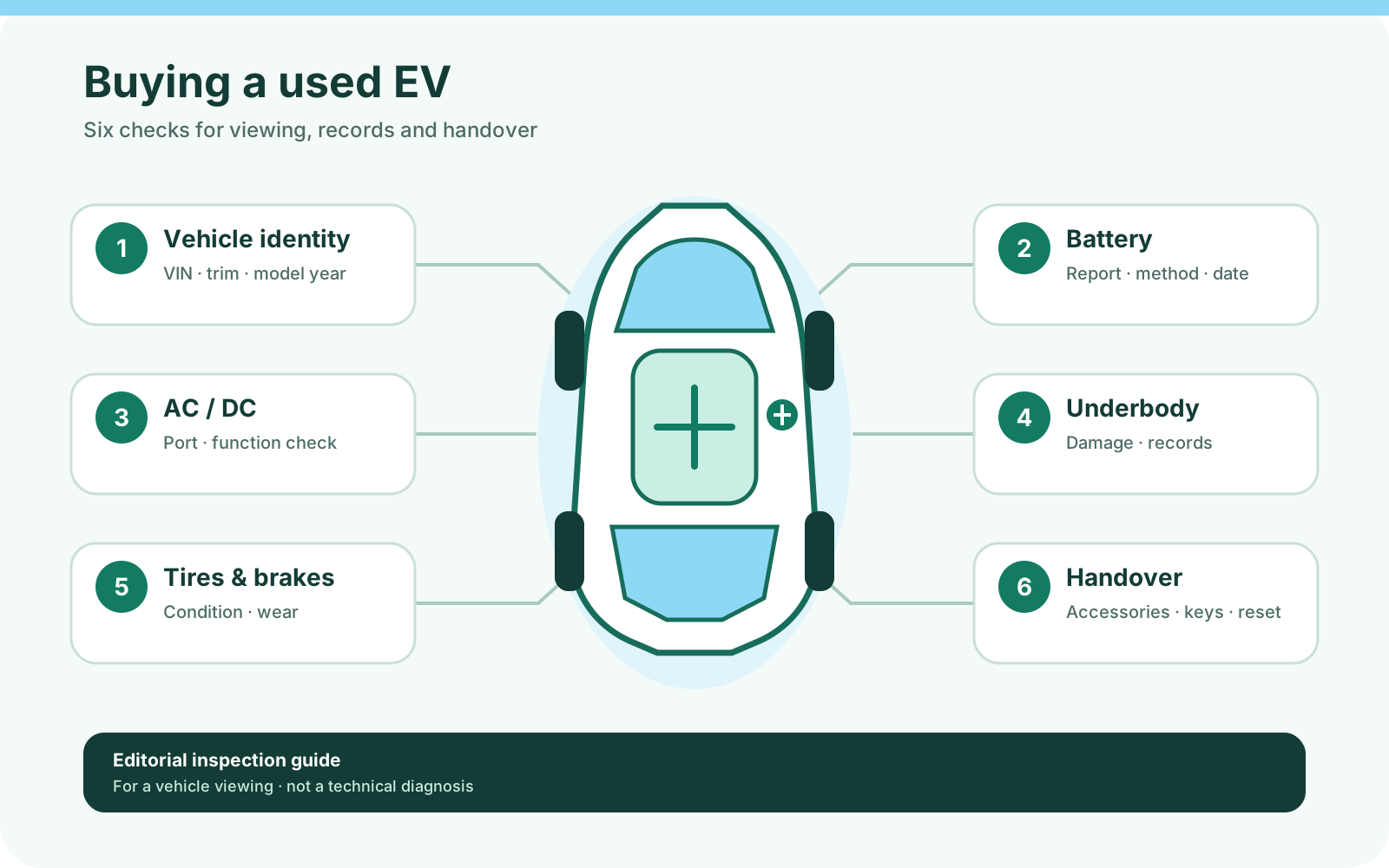
Six checkpoints for a used-EV viewing. ev.guru · AI-assisted inspection diagram · Original editorial illustration
Sources: [1]
What the battery evidence means for your trips
If the seller sends a screenshot of a full battery, use it as a record of what the display showed at that moment. State of charge tells you how full the battery is. The displayed range is an estimate affected by recent driving, weather, climate use, tires and software. Neither figure directly measures the usable capacity left in the battery.
Ask for evidence that this vehicle and its manufacturer actually support: a dated manufacturer diagnostic, a service report tied to the VIN, or a report from a test provider independent of the seller. Then ask how the result was obtained. Keep the method, starting and ending charge levels, temperature or driving conditions, software or tool, and the capacity used as the “new” reference together. Percentages from different methods are not automatically comparable.
Arrange permission before a connected test begins. If an OBD- or cloud-connected service will transmit vehicle or driving data, the owner must authorize the test. Review the provider’s privacy notice for the data sent, the recipients and deletion before connecting it.
A warranty also needs checking against the exact car. DOE notes that batteries are designed for extended life but wear over time, and that multiple manufacturers offer eight-year/100,000-mile warranties. Your applicable duration, mileage limit, capacity threshold, exclusions and transfer terms still come from the U.S. model-year warranty booklet and a VIN-specific confirmation.
Now put the capacity evidence next to a trip you actually need to make. In this hypothetical example, a documented method supports 60 kWh of current usable capacity. Assume the car uses 29 kWh per 100 miles from the battery and you want to arrive with a 15% reserve:
60 kWh × 0.85 ÷ 29 kWh/100 mi × 100 = about 176 miles
A regular 220-mile trip needs a charging stop under those assumptions. Decide whether that stop would work for you. This is a planning example, not an EPA rating, a resale grade or a forecast for a particular car.
Repeat the calculation with a less favorable case: speed, temperature, elevation, climate control and your chosen reserve all matter. If that route is central to the purchase, use the route planner with the same battery-side consumption basis and check a backup charging location.
Sources: [5]
Test Level 1, Level 2 and DC capability without unsafe improvisation
Inspect the inlet, covers and included equipment visually, without touching pins or opening the battery enclosure or any high-voltage component. Match each cord and adapter to exact model-year manufacturer guidance. Do not improvise an adapter chain. Visible damage or loose parts end the charging demonstration pending qualified diagnosis; if the connector, cable or equipment becomes unusually hot, stop the session safely according to the equipment instructions and have it assessed.
Agree which charging modes will be demonstrated. On compatible equipment, record starting charge, temperature, prior driving, indicated power, elapsed time, energy and warnings. Confirm that each agreed session starts, continues and ends without an error under those documented conditions.
One short session cannot certify the port for future use, measure total battery capacity or reproduce a brochure peak. Charging power depends on the vehicle limit, battery temperature and charge level as well as the station. If a station receipt says it delivered 18 kWh in 20 minutes, the average station-side rate was 54 kW because 18 kWh ÷ 0.333 hour ≈ 54 kW. That is not the car’s peak and not the energy retained in the battery. It is a reproducible record of that session. A repeated fault or a seller’s refusal to complete an agreed safe test should remain unresolved until diagnosed.
Home charging needs a separate energy-gap calculation. Assume a 60-mile demanding day and 32 kWh per 100 miles measured at the wall. The car needs 19.2 kWh replaced. Ten hours at an assumed 1.4 kW Level 1 rate can deliver at most 14 kWh before interruptions, leaving a 5.2-kWh daily gap. Five such days leave 26 kWh unrecovered. At 7.2 kW Level 2, the ideal quotient for 19.2 kWh is about 2 hours 40 minutes. Real charging can take longer, and the circuit and EVSE require proper evaluation and installation. This household needs suitable Level 2 access, fewer daily miles, workplace charging or a different plan. DC peak power does not solve an overnight AC deficit at home.
Sources: [4]
Read the dealer Buyers Guide and the exact warranty documents
For a covered dealer sale, inspect the FTC Buyers Guide posted on the vehicle and keep the final copy. The Guide identifies whether the vehicle is offered “as is,” with implied warranties only, or with a dealer warranty. Only when the dealer offers a warranty does its warranty section state covered systems, duration and the dealer’s share of repair costs. The Guide also warns that oral promises are difficult to enforce. The federal Used Car Rule applies to most dealers selling more than five used vehicles in 12 months, with specified exceptions; Maine and Wisconsin use similar state-required disclosures and are exempt from the federal rule. The federal Buyers Guide requirement does not apply to a private-party sale.
The Buyers Guide is not a battery report, title history or complete written warranty. FTC guidance says final negotiated warranty changes must appear on it, while an offered written warranty remains a separate document. Compare the final Guide, contract and warranty before signing. State law can change the consequence of “as is.”
For remaining manufacturer coverage, record in-service date, mileage limit, capacity threshold, diagnostic method, transfer terms and exclusions. Separate it from dealer warranty and service contract. Obtain repair orders for battery, charging, collision, flood or underbody work. A replaced module does not prove a complete new pack or restarted warranty; the invoice must identify the work.
This worksheet assigns zero dollars to federal used-EV purchase incentives. Add an incentive only when an official rule current for the transaction confirms eligibility; state, utility and local programs have separate requirements.
Correct the deal price and annual operating budget separately
Turn each known deficiency into a quote. An example uses a $24,000 asking price, then adds a replacement cord quoted at $450, tires at $900, inspection at $200 and required home electrical work at $1,600: $27,150 near-term cash. These are assumptions, not market prices; replace them with local quotes and keep financing, insurance, registration and tax separate.
Calculate energy with one basis. Assume 15,000 miles per year and 32 kWh/100 miles from the wall: annual energy is 4,800 kWh. If 80% is home charging at an assumed $0.18/kWh and 20% is public charging at an assumed $0.48/kWh, the example is:
4,800 kWh × (0.80 × $0.18 + 0.20 × $0.48) = $1,152 per year
Do not add charging losses again because the input already measures wall energy. The example excludes session fees, taxes, parking, memberships and demand charges. A renter or public-dependent driver should replace the 80/20 split with accessible locations and station prices. Keep one-time electrical work outside cents per kWh unless you deliberately amortize it over a stated ownership period.
Decide what is ready, what needs a quote and what makes you pause
Use the six checks below to turn the inspection into a decision. Keep each piece of evidence next to its consequence: a battery result does not settle a VIN conflict, explain a charging fault or make home charging available.
You can move forward when the identity and records agree, battery evidence supports the conservative use case, documented charging checks finish without errors and the full cash requirement fits. If a replaceable item is missing or an understood limitation has a cost, use a written quote when renegotiating.
Pause for a VIN or title conflict, an unresolved high-voltage warning, a refused inspection or a home-charging plan that has not been verified. Resolve those points before committing to the car.
At handoff, check the keys, portable EVSE, approved adapters, manuals, Buyers Guide, warranty and repair records against what was promised. Have the seller remove the car from the manufacturer account and erase profiles, phones and saved locations. Verify the reset before creating your own account; the seller’s charging accounts and payment methods must not transfer to you.
Identity and history
Record: VIN, model year, trim, drivetrain, title and build evidence
- Ready to buy if
- The vehicle and documents agree on the configuration.
- Negotiate if
- A promised, replaceable item is missing and has a written quote.
- Resolve before signing if
- VIN, title or a material trim claim conflicts with the paperwork.
Traction battery
Record: Dated VIN-linked report with method and comparison basis
- Ready to buy if
- The evidence is coherent and the conservative route case fits.
- Negotiate if
- A measured limitation is understood and priced into the deal.
- Resolve before signing if
- A warning remains, the method is unknown, or an agreed inspection is refused.
AC and DC charging
Record: Starting charge, temperature, station, time, energy and messages
- Ready to buy if
- The agreed tests finish without errors under documented conditions.
- Negotiate if
- A diagnosed, repairable issue has a written estimate.
- Resolve before signing if
- A session fails and its cause remains unresolved.
Recall and warranty
Record: NHTSA result, repair orders, booklet and VIN-specific terms
- Ready to buy if
- Open work and remaining coverage are documented.
- Negotiate if
- A scheduled item has a defined cost and completion plan.
- Resolve before signing if
- Recall completion, prior battery work or coverage cannot be verified.
Household charging fit
Record: Wall energy, parking hours, circuit assessment and backup sites
- Ready to buy if
- The demanding normal day can be restored with reserve.
- Negotiate if
- A quoted charging upgrade closes the measured gap.
- Resolve before signing if
- The plan depends on an unverified outlet, adapter or station.
Physical and digital handoff
Record: Keys, cord, adapters, records, app account and data reset
- Ready to buy if
- All promised items transfer and the seller completes account removal.
- Negotiate if
- A missing non-safety item has a replacement quote.
- Resolve before signing if
- The seller cannot remove access or material promised equipment is unexplained.
Sources & further reading
- NHTSA: Check for Recalls ↗
- Federal Trade Commission: Dealer's Guide to the Used Car Rule ↗
- Federal Trade Commission: Used Car Rule, 16 CFR Part 455 ↗
- DOE Alternative Fuels Data Center: Maintenance and Safety of Electric Vehicles ↗
- DOE Alternative Fuels Data Center: Electric Vehicle Benefits and Considerations ↗
Check current terms and details at the linked sources before deciding.