A matching plug is only the first check
Choose home equipment for the car’s AC inlet; choose a road-trip adapter only for a documented DC connection at sites your exact vehicle can access. If your existing approved equipment covers your overnight energy need, keep it. If a trip requires an adapter with no clear vehicle and network approval, choose a different stop instead of buying on the strength of a matching plug.
This guide is for U.S. buyers comparing vehicles or charging accessories. It is a source-based buying guide, not an adapter test or a list of certified products. We checked the linked public sources on September 16, 2026; eligibility still needs checking for the actual car and site before purchase or travel.
Write down model year, trim, market, AC inlet, DC inlet and onboard AC limit before shopping. Then read an adapter listing in one direction: charging equipment → adapter → vehicle. A label such as NACS adapter leaves both the direction and AC/DC use unresolved.
What to buy—and when to buy nothing
Use these cases to narrow a purchase, then check the vehicle manual and the operator’s current eligibility tool. They are decision rules, not approval of a particular accessory. A native connector removes one extra connection, but still does not prove network access or sufficient delivered power.
| Your situation | Sensible next step | What it does not solve |
|---|---|---|
| J1772 AC at home | Choose native J1772 equipment, or keep an approved setup that meets your overnight need. | An AC connection does not provide Supercharger access. |
| CCS1 car at an eligible NACS Supercharger | Confirm exact-vehicle access and the DC adapter supplied by Tesla or the vehicle manufacturer. | A third-party sales claim cannot override Tesla’s adapter policy. |
| 2026 LEAF at home | Use its J1772 AC path; Nissan lists a 7.2 kW onboard charger. | Its separate NACS DC inlet is not the home AC purchase target. |
| Compatible direct connection or station-provided adapter | Check the site and vehicle first; you may need no personal adapter for that stop. | One suitable stop does not cover a whole route or replace a backup. |
AC home charging and DC road charging are different purchases
The U.S. Department of Energy Alternative Fuels Data Center separates AC Level 1, AC Level 2, and DC fast charging. It describes J1772 at common AC equipment, J3400 at AC and DC equipment, and CCS1, CHAdeMO, and J3400 as DC fast-charging systems. Charging time depends on battery state, capacity, the vehicle charger, equipment output, and electrical service. A station’s largest number is therefore not a promise of what one car will accept.
At home, alternating current reaches the vehicle’s onboard charger, which converts it to DC for the battery. For road-trip fast charging, the station supplies DC through a vehicle-supported DC path. An AC adapter does not establish DC compatibility, even when the connector family looks similar. Before buying an adapter, identify both directions—equipment side and vehicle side—and whether it is approved for AC or DC.
SAE’s public J3400 scope covers either DC or single-phase AC transfer; it does not say every J3400 vehicle can use every J3400 station. SAE’s J3400/1 information report covers adapter suitability between J3400 and J1772 and focuses on an OEM-qualified device designation process. Use an adapter approved for the vehicle and charging direction; the public scope is not a universal compatibility list.

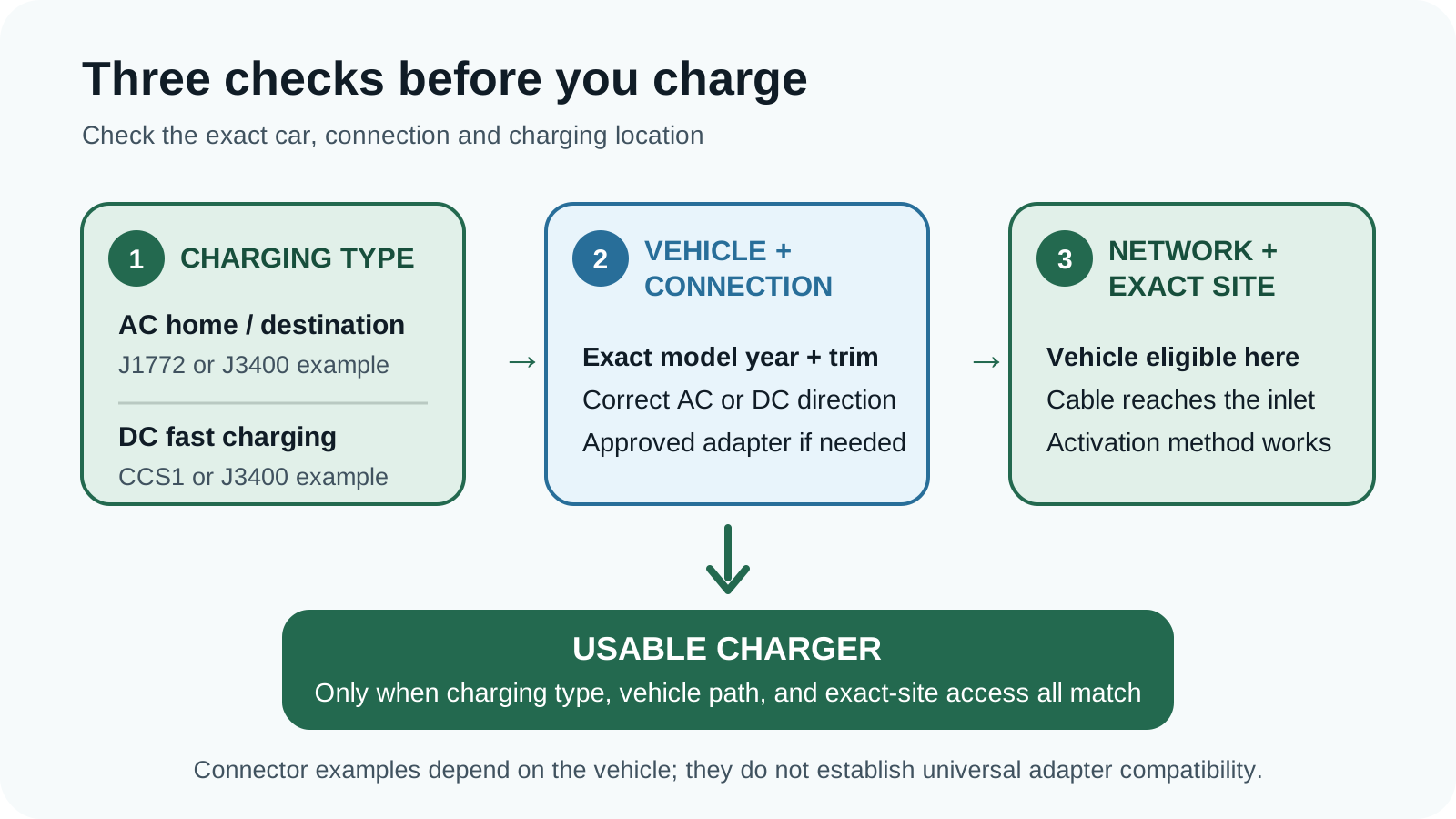
Three checks for US charging: AC/DC charging type, the exact vehicle and approved connection, and network/site access. Connector names are vehicle-dependent examples. ev.guru · AI-assisted compatibility diagram · Original editorial illustration
One exact model year shows why the details matter
The 2026 Nissan LEAF S+ is a documented example. Nissan’s current specifications list 75 kWh usage/net battery capacity for the S+. Its brochure lists a J1772 port for Level 1 and Level 2 AC charging, a 7.2 kW onboard AC charger, and a built-in NACS port for DC fast charging. One car therefore uses different physical paths for AC and DC.
Nissan also sets a specific adapter boundary. Footnote 38 of the brochure says a CCS adapter provided by Nissan or purchased from a U.S. Nissan dealership is the only adapter Nissan deems compatible with the 2026 LEAF, and it prohibits other adapters. That statement belongs to the 2026 LEAF. Do not transfer it to an older LEAF, another Nissan, or another manufacturer. A seller saying CCS adapter included is insufficient; match the actual part and documentation to the vehicle.
A 7.2 kW onboard charger does not become a 19.2 kW charger on higher-output Level 2 equipment. Lower-output equipment may instead lengthen recovery time. Electrical service, equipment, cord, inlet, and vehicle limit must agree.
Calculate the home need before choosing hardware
Begin with energy rather than a charger marketing number. Suppose a household drives a hypothetical 40 miles per day, assumes 0.30 kWh per mile from the battery, and uses a 90% AC charging-efficiency assumption. Daily battery energy is 40 × 0.30 = 12.0 kWh; estimated wall energy is 12.0 ÷ 0.90 = 13.33 kWh. This is a planning example, not a rating for the LEAF or any other car.
At a constant hypothetical 1.9 kW, replacing 13.33 kWh takes about 13.33 ÷ 1.9 = 7.0 hours. At 7.2 kW it takes about 1.85 hours. AFDC uses 1.9 kW in its Level 1 illustration and notes that Level 2 output can span 2.9 to 19.2 kW; real time also depends on the vehicle and battery conditions. Replace the assumptions with the car’s consumption, delivered power, and measured energy after installation.
The practical threshold is your parking window. In this example, an eight-hour overnight stay would cover the calculated Level 1 recovery; a five-hour stay would not. Cold weather, reduced outlet power or extra driving can erase that margin. Do not buy higher output solely because the plug fits: check the car’s AC limit and have the electrical installation assessed first.
For cost, multiply wall energy by the applicable utility rate and add fixed plan, demand, installation, permit, panel, or service-upgrade costs separately. Do not use battery-side kWh as though the utility bills at the battery. The ev.guru calculator can compare mileage, consumption, efficiency, and electricity rate; a qualified local professional still reviews circuit and installation requirements.
| Home AC example | Input power | Approx. time |
|---|---|---|
| Level 1 | 1.9 kW | 7.0 h |
| Level 2 | 7.2 kW | 1.85 h |
Sources: [1]
A NACS-shaped plug does not prove Supercharger access
Tesla distinguishes Tesla-only Superchargers, All EVs sites with a station-provided Magic Dock, and NACS sites opened gradually by vehicle manufacturer. It tells non-Tesla drivers to add the exact vehicle in the Tesla app or use its map to see compatible sites. For a CCS1 vehicle at an eligible NACS site, Tesla requires an NACS DC adapter supplied by Tesla or the vehicle manufacturer and prohibits third-party adapters. Tesla also warns that using an AC adapter at a Supercharger may damage the vehicle.
Network eligibility can change independently of the connector. Check the exact vehicle in the network or automaker tool before purchase and travel. Record whether activation uses the vehicle, an app, a terminal, or another supported method; a station pin or general brand list is insufficient.
Cable reach is separate. Tesla notes that port location can make some Supercharger cables difficult to reach and advises against diagonal parking. Inspect site guidance and preserve an independent backup rather than blocking another charging position.
Sources: [4]
Read station data at the correct level
AFDC distinguishes a station location, an EV charging port, and a connector. One port powers one vehicle at a time even when it has multiple connector types. Two connector labels on one port do not mean two cars can charge simultaneously. Use the ev.guru station finder to check connector, physical port count, and reported power around home, a regular destination, a frequent corridor, and one backup. Register data does not claim live availability, working status, price, or vehicle authorization.
For each critical stop, confirm exact-vehicle eligibility, the approved adapter, cable reach, activation, and an independent compatible backup. High station power cannot compensate for missing authorization or the wrong charging direction.
Sources: [1]
Price the missing capability, not a box of accessories
Before paying, ask what the purchase adds: a useful charging location, shorter overnight recovery, or simply a duplicate of equipment already supplied with the car. List the approved part, tax, shipping and any required installation in a written total. Confirm return terms before opening or using an accessory; this guide does not verify a live adapter price, stock position or refund promise.
For home charging, compare the installed setup rather than only the charger sticker price. For a road-trip adapter, compare the specific extra stops it makes usable with the direct-connection route you can already take. The alternative can be no purchase, a different charging stop, or delaying hardware until the vehicle is chosen. Carrying extra equipment also means storing it, checking its condition and following its connection instructions.
The linked home-charging adviser can lead to a disclosed affiliate offer for AC equipment. That commercial relationship is not approval of a DC adapter, and no adapter offer is recommended in this guide. Manufacturer and network restrictions take precedence over a seller’s compatibility claim.
Eight decisions before signing
The right choice is a documented path from electrical supply to the exact vehicle at home, plus compatible, accessible primary and backup stations on the trips the buyer makes.
- Record the exact model year, trim, market, and installed inlet or inlets.
- Separate the AC home-charging path from the DC fast-charging path.
- Confirm the onboard AC limit and realistic overnight wall-energy need.
- List every included adapter by part, direction, AC or DC use, and manufacturer approval.
- Verify network eligibility for that vehicle instead of relying on a brand-wide announcement.
- Check home, destination, corridor, and backup locations for compatible physical ports.
- Confirm cable reach, activation, and current operator information for critical stops.
- Put promised charger cords and approved adapters in the sales paperwork before paying.
Sources & further reading
- U.S. DOE Alternative Fuels Data Center: Electric Vehicle Charging Stations ↗
- SAE International: J3400_202409 public scope and status ↗
- SAE International: J3400/1_202504 public scope and status ↗
- Tesla Support: Supercharging Other EVs ↗
- Nissan USA: 2026 Nissan LEAF Specs & Trims ↗
- Nissan USA: 2026 Nissan LEAF brochure ↗
Check current terms and details at the linked sources before deciding.