Put EPA range in the context of your trip
The most useful road-trip plan is a short energy budget tied to a specific vehicle, route, forecast, charging location, and backup. Before departure, establish how much battery energy each leg needs, what state of charge you want in reserve, whether the selected station works with the car, and how much energy you must add before leaving it.
EPA range is a standardized comparison, not a guarantee for one highway trip. Nissan lists up to 303 miles of 2026 EPA-estimated range for the LEAF S+ and says actual mileage varies with trim, options, and driving conditions. Its brochure also qualifies charging time and capacity by power source, temperature, battery condition, age, and accessory use. This guide therefore uses that model in a transparent worksheet rather than treating 303 miles as a 303-mile highway plan.

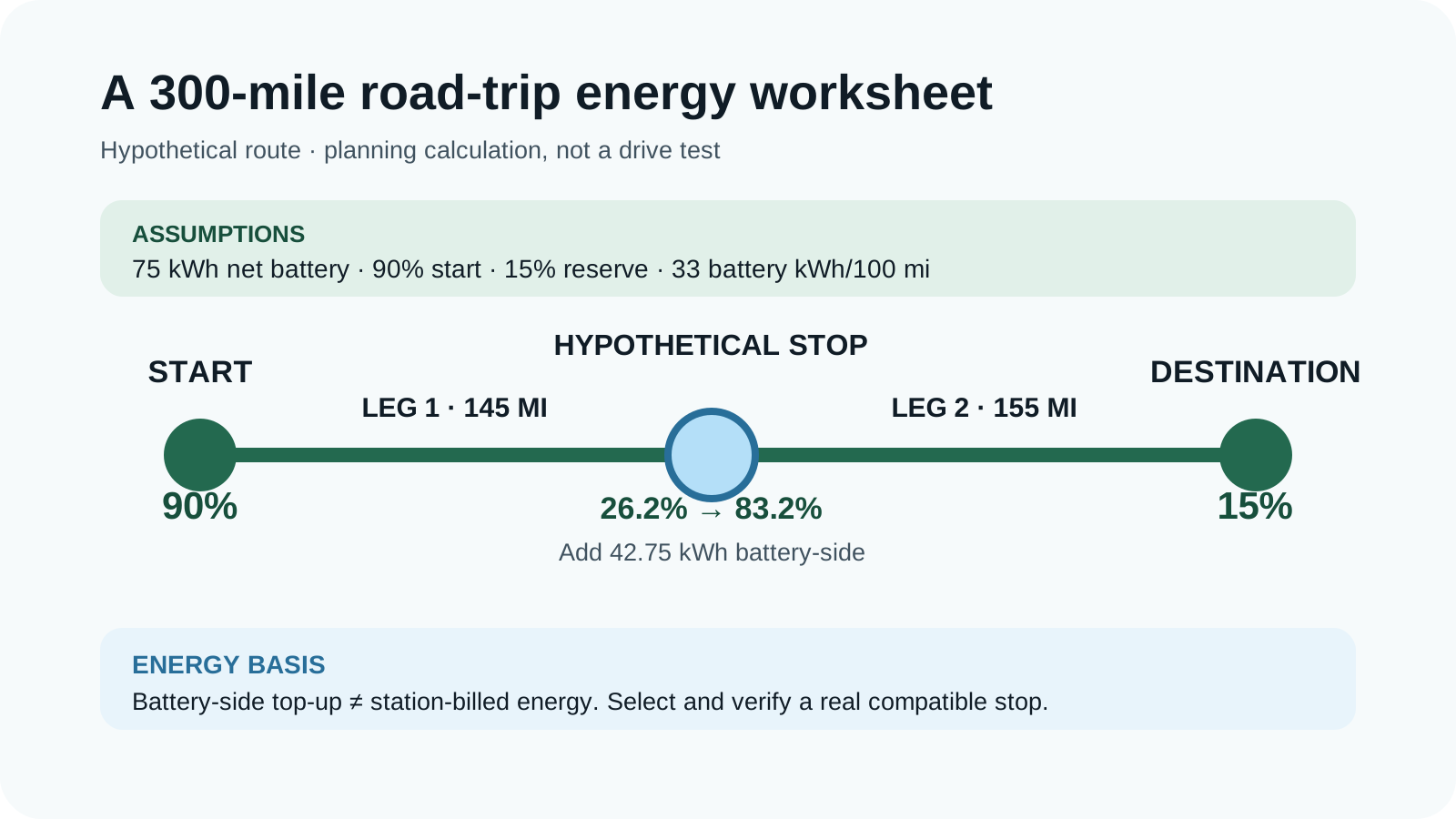
A hypothetical 300-mile trip in 145- and 155-mile legs, with battery energy and reserve. Battery top-up differs from station-billed energy. ev.guru · AI-assisted route worksheet · Original editorial illustration
Start with four numbers you can defend
Write down usable battery energy, a battery-side highway consumption assumption, starting state of charge, and minimum arrival reserve. Nissan’s 2026 LEAF specifications list 75 kWh as the S+ Usage/Net Battery Capacity, so this example uses 75 kWh as its planning capacity. It assumes 33 kWh per 100 miles from the battery, starts at 90%, and preserves 15% at the destination. The 33 kWh figure is a hypothetical planning assumption, not an EPA label value or a road-test result. Replace it with your own relevant highway result for the expected speed, load, and temperature.
At 90%, the example starts with 75 × 0.90 = 67.50 kWh. The 15% reserve is 75 × 0.15 = 11.25 kWh. On a hypothetical 300-mile route, a hypothetical charging stop at mile 145 creates legs of 145 and 155 miles. In actual planning, select a real registered station and use its routed leg distances rather than straight-line distance.
Leg 1 uses 145 × 33 ÷ 100 = 47.85 kWh. Arrival energy is 67.50 − 47.85 = 19.65 kWh, or 26.2%. Leg 2 requires 155 × 33 ÷ 100 = 51.15 kWh; adding the 11.25 kWh destination reserve means leaving the stop with 62.40 kWh, or 83.2%. The planned top-up is 62.40 − 19.65 = 42.75 kWh of battery-side energy, equivalent to 57.0 percentage points.
Battery-side gain and station-billed energy are different measurement boundaries. Charging losses and thermal conditioning can make billed energy higher. Use the state-of-charge target to manage the drive, then use the station meter and posted price to estimate and verify the bill.
| Calculation | Leg 1 | Leg 2 |
|---|---|---|
| Distance (mi) | 145 | 155 |
| Assumed use (kWh/100 mi) | 33 | 33 |
| Leg energy (kWh) | 47.85 | 51.15 |
| Departure (%) | 90.0 | 83.2 |
| Arrival (%) | 26.2 | 15.0 |
| Top-up before leg (kWh) | — | 42.75 |
Sources: [2]
Adjust energy use for weather and terrain
A weather reserve should change a stated assumption, not disappear inside a vague extra percentage. The U.S. Department of Energy reports that battery-electric vehicles are more sensitive to ambient temperature than combustion vehicles, and its cited Argonne testing found model-dependent effects from HVAC demand, battery chemistry, and thermal-management design. Speed, grade, acceleration, and other operating conditions also matter. That evidence does not justify one universal winter penalty for every EV.
For a sensitivity check, raise the assumed highway use from 33 to 36 kWh per 100 miles while keeping the same route and 15% destination reserve. Leg 1 then uses 52.20 kWh and arrives with 15.30 kWh, or 20.4%. Leg 2 uses 55.80 kWh; adding the 11.25 kWh reserve requires departure with 67.05 kWh, or 89.4%. The top-up grows to 51.75 kWh.
The first leg remains arithmetically reachable, but arrival is only 5.4 percentage points above the chosen reserve. If any case requires more than 100% at departure, the plan is impossible under those assumptions: choose a closer stop, add a stop, shorten the leg, or revise the input using credible vehicle data. Never erase that warning by clipping the answer to 100%.
Recheck the forecast shortly before leaving. In cold conditions, preconditioning while connected can draw cabin and battery preparation energy from the grid. DOE describes that mechanism, but the benefit depends on vehicle and conditions; follow the vehicle manual rather than assuming identical behavior across models.
| Calculation | Leg 1 | Leg 2 |
|---|---|---|
| Distance (mi) | 145 | 155 |
| Assumed use (kWh/100 mi) | 36 | 36 |
| Leg energy (kWh) | 52.20 | 55.80 |
| Departure (%) | 90.0 | 89.4 |
| Arrival (%) | 20.4 | 15.0 |
| Top-up before leg (kWh) | — | 51.75 |
Sources: [4]
Select a station the vehicle can actually use
The ev.guru route tool can calculate an original route, let you choose one registered charging stop, and show the two resulting legs. It is not a multi-stop optimizer, and register data does not claim live occupancy or operating status. Use the selected-stop result for leg distances, then verify the location in the network’s current app or site before departure.
The Department of Energy Alternative Fuels Data Center locator is a second official discovery source. Filter by connector and public access, then confirm the exact site, operator, hours, power, parking restrictions, and vehicle compatibility in a current operator source. A connector match alone does not establish access.
Connector rules depend on model year and manufacturer. The 2026 LEAF has J1772 for Level 1 and Level 2 AC charging and built-in NACS for DC fast charging. Nissan says only a CCS adapter provided by Nissan or bought from a U.S. Nissan dealership is compatible with the 2026 LEAF and prohibits other adapters. Do not transfer that rule to another vehicle or model year.
Tesla says only selected Supercharger sites serve other EVs. NACS-equipped vehicles do not need an adapter at compatible NACS sites; a CCS1 vehicle needs a supported NACS DC adapter supplied by Tesla or its manufacturer. Tesla prohibits third-party adapters and tells non-Tesla drivers to add the exact vehicle in its app or use its map to identify compatible sites. Cable reach can also vary with charge-port location.
Confirm payment, access, and an independent backup
Treat payment setup as route preparation. Tesla says non-Tesla drivers can pay through its app, while direct card, mobile payment, or text-to-pay exists only at a limited number of sites. Its app supplies site pricing, compatibility, and availability; those current details belong to Tesla and are not promised by a static route plan.
Electrify America says price depends on location, plan, and delivered energy. Some locations use time-of-use pricing, idle fees may apply, and the current price appears in the app or on the charger. Electrify America also says it does not support QR-code payment. A QR sticker requesting payment is a reason to stop and use the official app, membership pass, or terminal instead.
A backup should be independently usable, not merely the next dispenser at the same site. Save a second compatible location before departure, ideally before the planned reserve would be consumed. Check its access hours, connector, and payment method. If a late-day leg has only one practical site, move the planned stop earlier rather than treating reserve energy as spare range.
Build the route in eight checkable steps
Complete these steps while parked and repeat the operational checks shortly before departure. Save the destination addresses and backup so a weak data connection does not erase the structure of the plan.
- Identify the exact model year and trim, documented planning capacity, AC and DC inlets, and manufacturer-approved adapter rules.
- Set starting state of charge, minimum arrival reserve, and a battery-side highway consumption assumption based on relevant driving or a deliberately conservative case.
- Calculate the original road route and verify both place results before using its distance.
- Choose a real registered station with the required connector and create the two routed legs.
- Calculate each leg’s energy, arrival state of charge, required departure state of charge, and top-up; reject a result above 100% departure charge.
- Run an adverse-condition case for the forecast, speed, elevation, or load while leaving the chosen reserve visible.
- In the official provider app or site, confirm exact-vehicle compatibility, current status, access, payment, posted price, and possible idle or congestion fees.
- Save an independent reachable backup and compare actual arrival state of charge with the plan before committing to the next leg.
Update the plan at the charger
The planned departure percentage is a target. If the first leg used more energy than expected, recalculate the second leg using the observed rate and preserve the reserve. If it used less, the conservative case may require less energy. Charging power changes through a session, and vehicle, charger, battery state, and temperature affect time. Nissan qualifies its published charging times on those factors; Tesla notes that charging slows at high state of charge.
Waiting for nearly 100% may take longer than charging within a faster portion of the curve, but only a real route with another compatible stop can establish whether leaving earlier is useful. This method does not predict traffic, occupancy, outages, or future consumption. It keeps the inputs visible: routed distance, assumed energy use, chosen reserve, vehicle compatibility, and provider-supplied operational facts.
Sources & further reading
- EPA: Electric & Plug-In Hybrid Electric Vehicles ↗
- Nissan USA: 2026 Nissan LEAF Specs & Trims ↗
- Nissan USA: 2026 Nissan LEAF brochure ↗
- U.S. DOE: Impact of Cold Ambient Temperatures and Extreme Conditions on Electric Vehicles ↗
- DOE Alternative Fuels Data Center: Electric Vehicle Charging Station Locations ↗
- Tesla Support: Supercharging Other EVs ↗
- Electrify America: EV Charging Cost and Pricing Plans ↗
- Tesla Support: Supercharging ↗
Check current terms and details at the linked sources before deciding.