Start with the daily recovery question
You get home in the evening and need the car again in the morning. The useful question is whether charging replaces that day's driving with time to spare. Keep a verified setup that already does the job; compare Level 2 when late arrivals, longer trips or a second car repeatedly leave a gap.
In the US, Level 1 uses 120-volt AC power; home Level 2 normally uses 240 volts. These describe the electrical supply, not the plug on the car or a guaranteed charging speed. Kilowatts (kW) describe power; kilowatt-hours (kWh) describe energy. The examples below use stated assumptions, not our own vehicle tests. Primary guidance was reviewed on September 16, 2026.
DOE's Alternative Fuels Data Center says overnight Level 1 can meet many owners' daily needs with a suitable nearby outlet on a dedicated branch circuit. Its case for Level 2 includes less predictable schedules and longer recovery needs. Your energy use and available hours matter more than a universal daily-mileage cutoff.
| Your situation | Start here | Check before spending |
|---|---|---|
| Low daily use, long nights | Keep suitable existing Level 1 if departure charge is reliably restored. | Verify the outlet, cord and sustained load; leave recovery time in reserve. |
| Short nights or recurring gaps | Request an appropriately sized Level 2 quote. | Match the car's AC limit and actual parking hours before buying more power. |
| Shared or rented parking | Settle access, permission and the charging schedule first. | Confirm who owns, pays for and maintains the installation; do not buy hardware first. |
Calculate daily wall energy and recovery time
Start with wall energy if you have it from a charging report, utility submeter or reliable EVSE record. Wall energy includes the losses between the electric meter and battery. If you only have a battery-side consumption estimate, divide by an explicit charging-efficiency assumption before comparing it with energy delivered by the circuit. Do not mix a battery-side vehicle number with billed wall kWh as though they were measured at the same point.
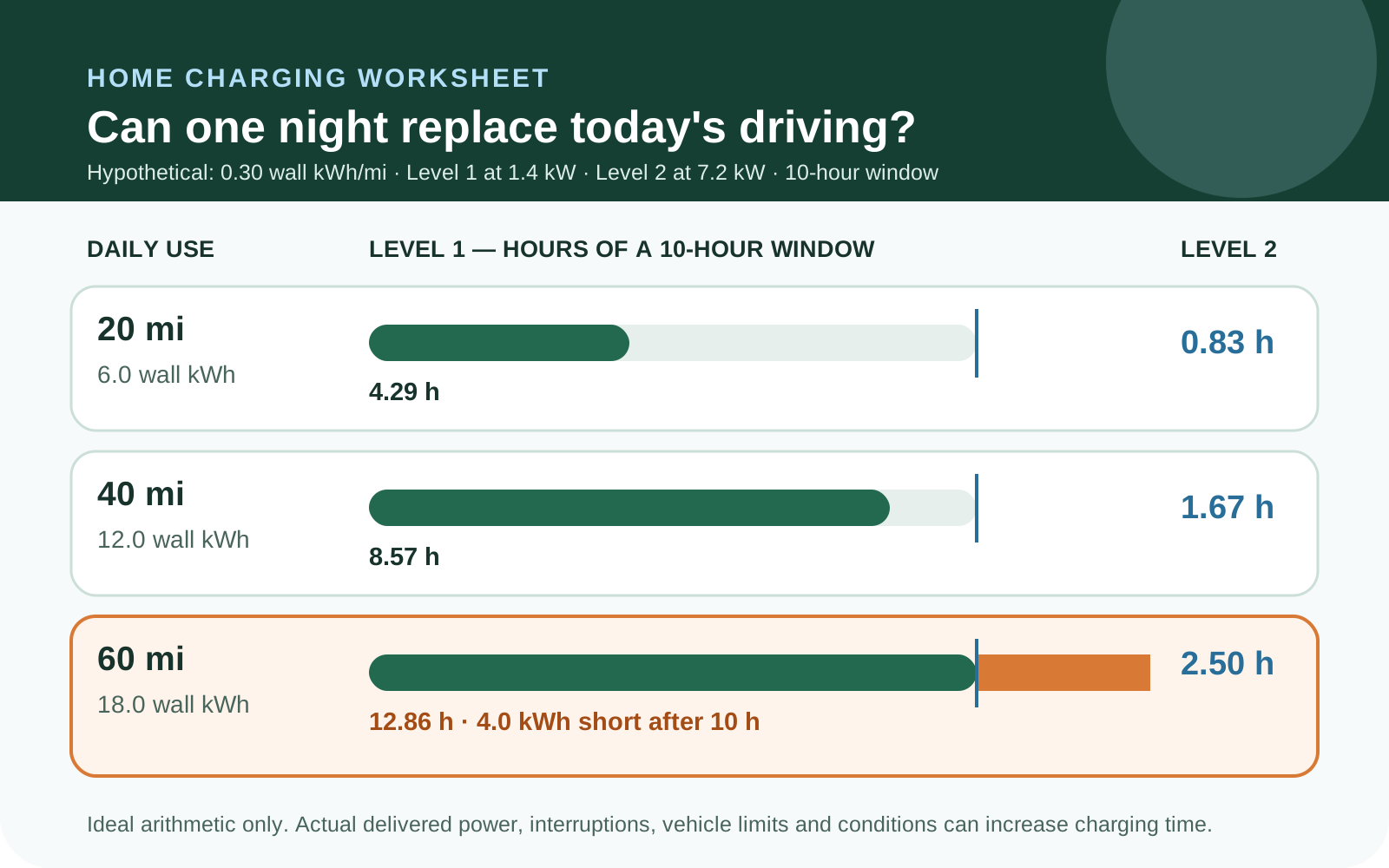
Consider a deliberately hypothetical comparison: 0.30 wall kWh per mile and constant delivered power of 1.4 kW for Level 1 or 7.2 kW for Level 2. Required wall energy equals miles multiplied by 0.30; ideal time equals wall energy divided by delivered power. A 20-mile day needs 6.0 wall kWh and ample margin in a ten-hour Level 1 window. A 40-mile day needs 12.0 kWh and fits mathematically, but delays or a shorter utility window can erase the margin.
A 60-mile day needs 18.0 wall kWh. Ten ideal hours at 1.4 kW deliver 14.0 kWh, leaving 4.0 kWh unrecovered. Five identical days leave a 20-kWh cumulative gap unless another charging opportunity closes it. At 7.2 kW, the same 18.0 kWh takes 2.50 ideal hours. Actual sessions can take longer because delivered power, vehicle limits, schedules and conditions vary. Table times are rounded to the nearest minute.
Check the catch-up plan as well. Closing that 20-kWh gap at 1.4 kW requires about 14 hours 17 minutes of additional charging with no new driving to replace. A quiet weekend might provide it; a busy weekend might not. The battery must also retain enough energy for every trip before catch-up. A weekly energy total alone does not prove that Friday's departure works.

Hypothetical recovery times for 20, 40 and 60 daily miles. Bars share one time scale and mark a ten-hour charging window. ev.guru · AI-assisted charging worksheet · Original editorial illustration
| Daily driving and wall energy | Level 1 time | Level 2 time |
|---|---|---|
| 20 mi · 6 kWh | 4 hr 17 min | 50 min |
| 40 mi · 12 kWh | 8 hr 34 min | 1 hr 40 min |
| 60 mi · 18 kWh | 12 hr 51 min | 2 hr 30 min |
Keep Level 1 when it closes the gap with margin
Level 1 can be the sensible long-term answer for a low-mileage battery EV, many plug-in hybrids or a household with long, predictable parking. Confirm that the cord supports the exact vehicle and use, and have a licensed electrician assess the outlet, wiring and branch circuit for sustained charging. The U.S. Fire Administration advises plugging Level 1 directly into a suitable outlet, without extension cords or multiplug adapters. A convenient garage socket is not proof of suitability.
Keep time in reserve. If the calculation needs every minute of a ten-hour window, ordinary interruptions turn a paper fit into a recurring shortfall. Track several demanding days: record miles, wall kWh and connected hours. If the car repeatedly returns to the intended departure charge without routine public fast charging, Level 1 is doing the job.
Choose moderate Level 2 when time is the constraint
Level 2 becomes useful when the normal energy gap exceeds Level 1's available window, the car arrives at inconsistent times, or the household needs to recover before a second trip. It can also concentrate charging inside an off-peak utility window. Faster charging does not make electricity cheaper by itself; the tariff and timing determine the bill.
Do not automatically buy the largest amp rating. The completed rate is limited by the commissioned circuit, the charging equipment (EVSE) and the vehicle's onboard AC charger. Nissan's US 2026 LEAF brochure lists a 7.2-kW onboard AC charger for S+, SV+ and Platinum+. More powerful home equipment cannot overcome that limit. The brochure separately identifies J1772 for Level 1/2 AC and the NACS port for DC fast charging: a NACS fast-charge port does not establish that a NACS home unit connects directly. Verify the exact vehicle, approved adapter path and model year.
A moderate setting may meet the schedule while avoiding unnecessary electrical work. Ask for quotations that separately describe the viable charging setting, circuit work, cable route, permit and inspection, load management if applicable, and any panel or service work. Comparing those line items is more useful than comparing wall-unit headline power.
Plan two-car and shared-property charging explicitly
Two vehicles do not simply double the needed hardware. In a hypothetical household, Car A needs 8 wall kWh and Car B needs 10. Both can accept a constant 7.2 kW, so their combined 18 kWh needs 2 hours 30 minutes of charging. But if A has only one hour before leaving again, it can receive just 7.2 kWh and leaves a 0.8-kWh gap even when B can wait all night. Test each departure deadline, then the total. Lower vehicle limits and time spent moving the cable make the schedule tighter.
One conveniently located unit can serve two cars when the timing works. Two units may avoid cable swaps, but their combined electrical demand still needs an approved design; each unit's headline power is not automatically available at the same time. Ask the installer to show how the proposed shared-power arrangement meets both departure targets.
For a rental or condominium, obtain written property approval before buying equipment or commissioning work. Settle circuit ownership, installation route, metering, electricity reimbursement, network access, maintenance and removal. DOE notes that multifamily charging brings additional considerations and may resemble public charging more than a single-family installation.
Sources: [1]
Treat the electrical assessment as part of the purchase
A receptacle shape does not establish usable capacity. EPA ENERGY STAR tells buyers to have a licensed electrician evaluate the home's wiring, outlets and other hardware for the EV's charging requirements. DOE says installations must follow local and state rules, may require permits, and are treated as continuous loads under the applicable electrical code. The contractor should evaluate service capacity, panel loading, breaker space, conductors, grounding, the receptacle or hardwired connection, cable route, mounting and exposure to weather or vehicle impact. Outdoor installations require equipment rated for that location.
Ask the contractor to document the maximum continuous charging current and commissioned EVSE setting. If capacity is tight, request an itemized comparison of a lower fixed setting, listed load-management equipment and a service upgrade. Do not assume an upgrade is required, and do not assume software alone can make an undersized installation safe.
AFDC recommends safety-certified equipment, including ENERGY STAR products tested by a nationally recognized testing laboratory. Certification does not replace correct installation or vehicle compatibility. Stop a session if the plug, receptacle, cable or equipment shows visible damage, looseness, unusual heat, odor, discoloration or repeated faults. Do not open electrical equipment or improvise repairs; use the qualified service route in the product and installation documentation.
Separate energy cost from the cost of gaining speed
For charging energy, multiply wall kWh by the applicable marginal electricity rate. In the 40-mile example, 12 wall kWh per day over 30 days equals 360 kWh. At a hypothetical $0.18/kWh, that is $64.80 per month; at $0.32/kWh, $115.20. Level 2 does not inherently reduce those 360 billed kWh. Any efficiency or scheduling benefit should be demonstrated with measured wall energy and the actual tariff.
Keep one-time costs in a separate column: equipment, new circuit, cable routing, trenching, mounting, permit, inspection, load management, panel work and service work. Keep recurring costs separate too: connected-service subscriptions, utility-program terms, an additional meter charge or demand-related charges. Conditions differ too much for a useful national installation-price promise.
A short cheap window makes the comparison more specific. Assume the same 12 wall kWh on each of 30 days, ten connected hours including four at $0.15/kWh and six at $0.30/kWh. Assume constant 1.4-kW Level 1 or 7.2-kW Level 2, enough vehicle acceptance, and identical wall-energy needs. Level 1 can place 5.6 kWh in the cheap window and must supply the remaining 6.4 kWh outside it. Level 2 can place all 12 kWh inside it. The table adds a hypothetical $5 monthly fee only to the Level 2 option. These are invented planning inputs, not a utility offer.
Level 2's extra benefit over already scheduled Level 1 is $23.80 per month here, not the saving against doing all charging at the expensive rate. If the installed upgrade costs an extra $1,200, dividing by $23.80 gives about 50.4 months before financing, repairs or price changes. That assumes the same use every month. Replace the tariff, fees and quote with your own figures, include any effect on the rest of the home's bill, and confirm eligibility before counting incentives. A faster setup can buy useful time even when energy savings do not repay it.
| Monthly item | Level 1 | Level 2 |
|---|---|---|
| Energy at $0.15/kWh | 168 kWh | 360 kWh |
| Energy at $0.30/kWh | 192 kWh | 0 kWh |
| Charging energy cost | $82.80 | $54.00 |
| Extra monthly fee | $0.00 | $5.00 |
| Monthly total | $82.80 | $59.00 |
Eight decisions for a usable handoff
Keep Level 1 when a verified setup closes the demanding daily gap with time to spare. Choose appropriately sized Level 2 when the gap recurs, the parking window is short, a second vehicle needs access or a real tariff window creates value. Buy the charging rate the household can use and the home can support.
- Record demanding normal-day miles, catch-up-day miles and actual overnight parking hours.
- Use measured wall kWh per mile where available; otherwise state consumption and charging-loss assumptions separately.
- Calculate the daily energy gap and ideal time at the power the completed setup can actually deliver.
- Verify the exact vehicle's AC inlet, approved adapter path and onboard AC limit by model year and trim.
- Have a licensed electrician assess the outlet, branch circuit, panel, service, cable route, grounding and location.
- Obtain written line items for circuit setting, equipment, permits, inspection, load management and service work.
- Check the actual utility tariff, charging window, recurring fees and incentive eligibility before counting savings.
- After installation, document the circuit and approvals, then verify a normal session and departure recovery.
Sources & further reading
- DOE Alternative Fuels Data Center: Charging Electric Vehicles at Home ↗
- DOE Alternative Fuels Data Center: Electric Vehicles for Consumers ↗
- EPA ENERGY STAR: Electric Vehicle Chargers ↗
- Nissan USA: 2026 Nissan LEAF Specs & Trims ↗
- Nissan USA: 2026 Nissan LEAF brochure ↗
- U.S. Fire Administration: Electric Vehicle Fire Safety ↗
Check current terms and details at the linked sources before deciding.