Start with eligible charging, not total driving
Stay with a free plan when public charging is occasional or unpredictable. Consider a paid plan when your regular, compatible stations deliver a positive saving even in a quieter month. For a road trip, compare the actual paid billing period and cancellation timing. The largest advertised discount is not automatically the lowest bill.
Count only sessions that receive the benefit. Home charging, workplace energy and another network’s sessions cannot repay this membership. Check whether an existing vehicle charging benefit already covers the planned sessions before buying another plan. Begin with two or three months of receipts and sort charging by network, station, time, activation method, delivered kWh and fees.
Keep four questions separate: the price at that station and time; vehicle and payment-method eligibility; the fee and renewal rules; and your likely eligible use. Price the same journey with and without the plan. A cheaper station that needs a detour is a different journey, so the extra energy and time also matter.
Use one formula for energy and session fees
Monthly plan advantage equals the sum of eligible kWh multiplied by each session’s per-kWh saving, plus avoided session fees, minus membership fees and any extra costs caused by choosing the plan. A positive result favors the paid plan. Use delivered, billed kWh; do not add a home-charging loss estimate to public receipts.
For one unchanged energy-price gap, divide the monthly fee by the saving per eligible kWh. When a plan also removes session fees, subtract those avoided fees first. When prices differ by site or time, calculate each part separately; neither the largest discount nor a simple average of station prices describes your charging mix.
The station prices and travel patterns below are hypothetical. EVgo’s listed subscription and session fees are separately sourced. EVgo and Electrify America worked totals exclude applicable tax and session-specific extras. With real bills, compare a consistent tax basis and do not add taxes already included in the input. Use the provider’s rounding on the final bill rather than treating a fractional-kWh threshold as a guaranteed saving.
EVgo: session count and station-specific prices both matter
EVgo’s pricing page, checked September 16, 2026, lists Pay As You Go at $0/month plus $0.99/session, Plus at $6.99/month and PlusMax at $12.99/month; both paid plans remove session fees. Advertised maximum savings are 15% and 30%, not a uniform kWh discount. Actual prices depend on station, time and usage; check each plan in the app. Subscription fees are not charging credit.
For the comparison below, assume the same station and time charges $0.56/kWh on Pay As You Go, $0.49 on Plus and $0.44 on PlusMax. These are invented worksheet rates, not observed EVgo prices. For 40 kWh in two sessions, the free plan costs 40 × $0.56 + 2 × $0.99 = $24.38. Plus costs $26.59 and PlusMax $30.59. Each row is a separate month; the plans cannot be ranked without both volume and session count.
At four sessions, Plus avoids $3.96 in session charges. Its remaining $3.03 fee needs about 43.3 kWh at the assumed $0.07 saving to break even against Pay As You Go. PlusMax then needs a separate comparison against Plus: the extra $6 monthly fee divided by the assumed $0.05 energy-price gap gives 120 kWh. At exactly 120 kWh those two paid plans tie; above it PlusMax costs less under these assumptions. Beating the free plan does not establish that the more expensive membership beats the cheaper one.
For direct credit-card starts, EVgo lists a separate $2.99 transaction fee. The table models account-plan sessions instead; it does not silently add both fees. Taxes and out-of-network charges may differ. EVgo’s help page says switching to Pay As You Go ends paid benefits immediately; switching between paid plans triggers the new subscription fee immediately. Check the account screen before changing plans, and do not assume a refund for unused days.
| Eligible charging | Pay As You Go | Plus | PlusMax |
|---|---|---|---|
| 40 kWh · 2 sessions | $24.38 | $26.59 | $30.59 |
| 90 kWh · 4 sessions | $54.36 | $51.09 | $52.59 |
| 150 kWh · 6 sessions | $89.94 | $80.49 | $78.99 |
Electrify America: a percentage still needs a local base price
Electrify America advertises about 25% lower charging prices with Pass+. Its pricing page directs drivers to the app or charger for the actual station rate and idle fees; some stations vary rates by time. A current dollar subscription fee is not exposed in the public page content reviewed on September 16, 2026. Copy the fee and both charging prices from your app instead of reusing an old fee from another comparison.
For a hypothetical Pass price of $0.48/kWh and an exact 25% discount, Pass+ would be $0.36 and save $0.12/kWh. With an assumed—not sourced—$7 monthly fee, break-even is about 58.33 eligible kWh. At 40 kWh the discount is $4.80, leaving $2.20 more cost; at 80 kWh it is $9.60, leaving $2.60 saved. Replace both inputs and use the app’s actual price difference rather than forcing 25%.
The provider says a Pass+ downgrade takes effect at the next billing cycle, on the signup anniversary; benefits continue until then. That differs from EVgo’s immediate loss of paid benefits. Electrify America also says remaining charging after an exhausted or expired complimentary Premium Offer falls to Pass pricing. Check your vehicle benefit’s limits before counting energy as eligible membership savings.
Sources: [3]
Tesla: confirm the vehicle, site and fee inside the app
A paid membership is not required at Superchargers open to other EVs. Add the exact vehicle in Tesla’s app to check compatible sites. A connector that fits does not establish access: Tesla permits relevant CCS1 vehicles with a Tesla- or manufacturer-provided NACS DC adapter and prohibits third-party adapters. A Tesla vehicle already receives its own pricing without this membership.
At select sites, membership gives other EVs Tesla-vehicle pricing when using Tesla’s app. The reviewed support page gives no single U.S. fee or price gap: obtain both from the app. Tesla says normal taxes and fees are included in its displayed charging price; congestion charges can be additional. Third-party app prices may differ. The monthly membership fee is non-refundable; cancellation is available anytime.
Example only: an eligible site shows $0.56/kWh without membership and $0.43 with it, and the app shows a hypothetical $12.99 monthly fee on the same tax basis. The $0.13 gap needs about 100 eligible kWh to recover the fee. At 60 kWh it saves $7.80 in energy but costs $5.19 more after the fee. At 140 kWh it saves $5.21 after the fee. Extra congestion or parking costs remain outside this model.
A second hypothetical month shows why one station’s discount cannot price the whole trip. Sixty kWh save $0.14 each at one site; another 40 kWh save only $0.03 each elsewhere. The combined discount is $8.40 + $1.20 = $9.60. Against a separately assumed $10 fee, that loses $0.40. Applying the first site’s $0.14 gap to all 100 kWh would wrongly promise a $4 saving.
Sources: [4]
Compare one travel month with paying all year
Compare paid billing periods, not just calendar months. A journey crossing a renewal date may incur two fees. Check when benefits start and end before scheduling a cancellation; EVgo and Electrify America have different downgrade timing. Do not assume that canceling a renewal refunds a fee already paid.
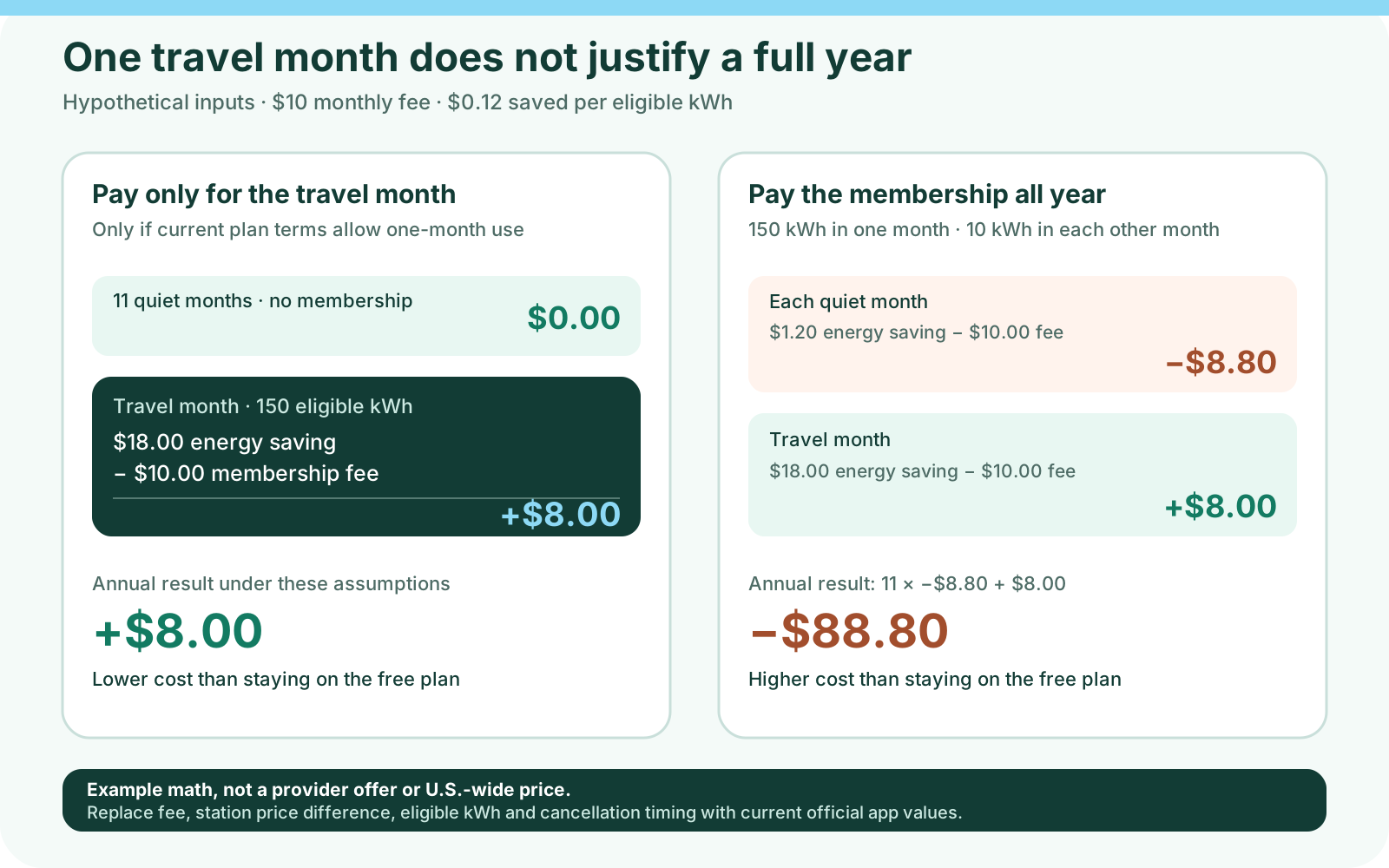
With a hypothetical $10 fee and $0.12 saving per eligible kWh, a 150-kWh travel month saves $18 in energy and $8 after the fee. Eleven quieter months of 10 kWh each lose $8.80 per month after the fee. Across the year, 260 kWh save $31.20 against $120 in fees: year-round membership loses $88.80. Activating only for the travel billing period saves $8 if the current terms and journey dates allow it.
At a steady 110 eligible kWh every month, the same model saves $13.20 before the fee and $3.20 after it, or $38.40 across twelve unchanged months. The table compares these different usage patterns and enrollment choices; do not add the rows. A small positive result calls for a lower-use check, not extra charging to make the subscription look useful.

A hypothetical charging membership saves money in one travel month but costs more over a full year. Check cancellation terms separately. ev.guru · AI-assisted membership diagram · Original editorial illustration
| Usage and enrollment | Fees (USD) | Saving (USD) |
|---|---|---|
| Only travel month · 150 kWh | 10.00 | +8.00 |
| All year · 260 kWh | 120.00 | −88.80 |
| All year · 1,320 kWh | 120.00 | +38.40 |
Price detours and a second membership separately
Return to the 90-kWh, four-session EVgo example: Plus saves only $3.27 against Pay As You Go. Suppose reaching the discounted site adds six round-trip miles for each session. Those 24 extra miles, at an assumed 31 billed kWh/100 miles and $0.49/kWh, add $3.65 in energy. The nominal saving becomes about $0.38 more cost, before valuing time or parking. This is an illustrative alternative journey, not a measured vehicle result.
Do not count the same kWh for two networks. If 180 monthly kWh split evenly between two hypothetical memberships, each costing $10 and saving $0.12/kWh, each plan gets only 90 eligible kWh. Their combined discount is $21.60 against $20 in fees: just $1.60 saved. At 140 kWh split evenly, the two fees exceed the $16.80 discount by $3.20. Each subscription needs its own lower-volume check.
Use the lowest-cost usable option for the journey, including a free payment route. A backup network can be valuable without a standing paid subscription. Station availability, vehicle access and a workable charging window come before optimizing a few cents.
Collect the values at the charger or in the official app
Choose the least expensive plan that works for a credible month, then recheck after three bills or when home access, vehicle, adapter eligibility or travel changes. Keep the activation screen and receipt so an unexpected charge can be traced to the station, payment path or billing period.
The ev.guru station finder uses registered connector and power data; it does not promise live availability or charging prices. Use the route planner to check the journey and the tariff comparison for your own current app values.
- Record the exact station and charging window for every recurring trip.
- Confirm vehicle, adapter and payment-method eligibility for that station.
- Copy both plan prices for the same conditions, noting whether tax is already included.
- Record the membership fee, billing date and any existing complimentary vehicle benefit.
- Estimate eligible kWh and sessions separately for each network in low, normal and travel periods.
- Add only relevant transaction, idle, congestion, parking and detour costs; avoid double-counting.
- Compare the paid tiers with each other as well as with the free plan.
- Check cancellation timing, the next renewal date and when benefits actually end.
Sources & further reading
- EVgo: Pricing ↗
- EVgo Help Center: Change your EVgo monthly plan ↗
- Electrify America: Pricing and Plans ↗
- Tesla Support: Supercharging Other EVs ↗
Check current terms and details at the linked sources before deciding.