Start with the energy on your bill
Build three totals: charging energy, additional recurring fees and one-time setup. Home access can lower the energy bill while requiring cash for installation; inexpensive workplace charging needs a usable fallback. This guide budgets charging, not complete vehicle ownership. Purchase or lease payments, depreciation, insurance, registration, tires and maintenance belong in a separate car-cost calculation.
A national electricity average cannot price one household’s charging. Assign energy to the places where the car will actually charge. At home, record electricity used for the car rather than the entire household. At a public station, use the energy metered and billed by the dispenser. Those are not automatically identical measurement points. Utility periods, workplace rules, public-station prices and fixed fees then determine the bill.
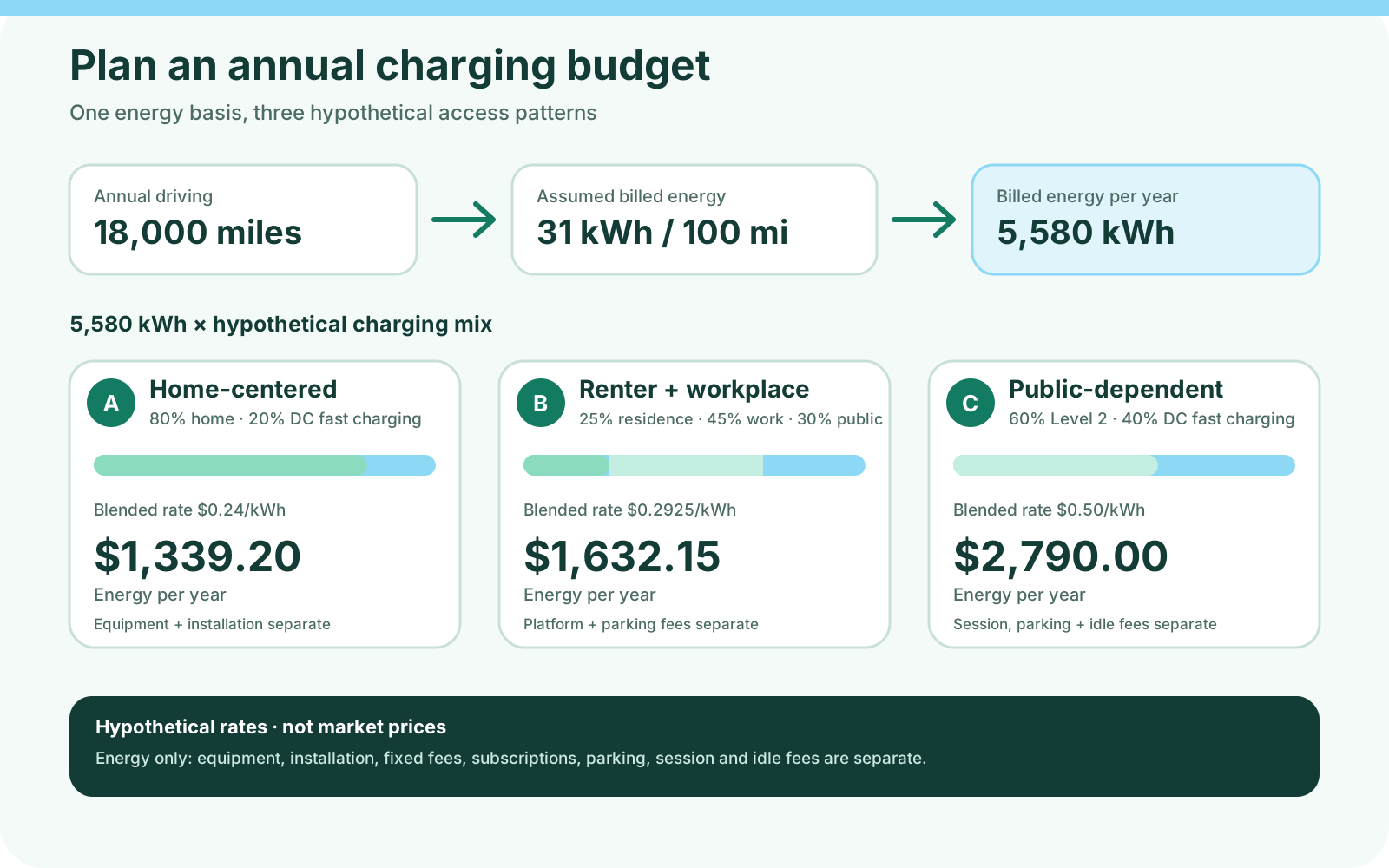
For an initial comparison, assume 18,000 miles and 31 billed kWh per 100 miles in every charging bucket. That produces 18,000 ÷ 100 × 31 = 5,580 kWh a year. Holding energy constant isolates access and price; it does not claim equal losses for home AC and public DC. Replace the annual assumption with same-period odometer miles and billed kWh totals for each charging location.
Do not add losses to a home input already measured at the grid meter. If only battery-side consumption is available for home AC, divide it once by a stated efficiency assumption: 27.9 battery-kWh/100 miles divided by an assumed 90% equals 31 grid-kWh/100 miles. Do not apply that home AC efficiency to public DC billing. DOE explains that charging cost needs both electricity price and vehicle efficiency, and that residential cost depends on equipment, time and duration. A catalog value can start the worksheet, but it is not a personal winter or highway guarantee.

Three US charging budgets at 18,000 miles per year. Assumed energy costs; equipment and fees are separate. ev.guru · AI-assisted budget diagram · Original editorial illustration
Sources: [1]
Compare three access patterns without changing the car
The three cases keep annual miles and the simplifying 5,580-kWh billed-energy total constant. Every price in these examples is hypothetical and before tax. The cards show energy only, not a U.S. price survey or complete bill. Substitute the price of additional charging kWh under your actual utility tariff, including applicable usage-based delivery charges, written workplace terms and each station’s displayed price. Add applicable tax once; do not add it again if your own input already includes it. Shares must total 100%, and fewer miles do not automatically reduce monthly fees.
The home-centered case buys 4,464 kWh at home and 1,116 kWh at public DC stations: $758.88 plus $580.32 equals $1,339.20. The renter case assigns 1,395 kWh to shared residential charging, 2,511 kWh to work and 1,674 kWh to public sites. Its $334.80, $376.65 and $920.70 add to $1,632.15. Fully public charging assigns 3,348 kWh to Level 2 and 2,232 kWh to DC, producing $1,406.16 plus $1,383.84. This breakdown lets you replace one access point without repricing every mile.
Home-centered household
$1,339.20energy per year
- Charging mix
- 80% home at an assumed $0.17/kWh; 20% public DC at $0.52/kWh
- Assumed blended price
- $0.24/kWh
- Additional costs
- EVSE, electrical work and public session or parking fees remain separate.
Renter with workplace access
$1,632.15energy per year
- Charging mix
- 25% shared residential at $0.24/kWh; 45% work at $0.15/kWh; 30% public at $0.55/kWh
- Assumed blended price
- $0.2925/kWh
- Additional costs
- Property platform, parking rent and workplace access fees remain separate.
Public-dependent driver
$2,790.00energy per year
- Charging mix
- 60% public Level 2 at $0.42/kWh; 40% public DC at $0.62/kWh
- Assumed blended price
- $0.50/kWh
- Additional costs
- Add session, parking, idle and membership fees; verify that the assumed sites are practical.
Test a time-of-use plan against the whole household
A time-of-use plan changes more than the EV line. Put charging kWh into periods when the car can really remain plugged in, then reprice air conditioning, heating, cooking and other household load. Compare required delivery and supply charges, fixed charges, credits and any minimum bill under both plans. An existing household fee that stays identical is not a new EV cost; a fee that changes with the plan must enter the comparison.
Southern California Edison illustrates why current billing details matter. Its time-of-use comparison, checked September 16, 2026, lists a $0.79 daily Base Services Charge for TOU-D-4-9PM, TOU-D-5-8PM and TOU-D-PRIME; PRIME has no baseline credit and has equipment eligibility requirements. SCE’s billing FAQ says the previous PRIME Basic Charge was replaced by the Base Services Charge in November 2025. Do not automatically add an old PRIME surcharge on top. Income-qualified discounts and a different generation supplier can change the address-specific bill; use the applicable tariff and personalized comparison, not these headline terms as a national offer.
The table below is a separate hypothetical plan change, not SCE pricing. Repricing 4,464 annual home-charging kWh from $0.31 to $0.16 saves $669.60. Repricing 1,000 kWh of other household use from $0.28 to $0.45 adds $170. A newly added $0.50 daily fee adds $182.50 over 365 days. Net savings are $317.10. All other household usage, existing charges and public charging are held unchanged; the table compares only changed bill items and excludes tax.
In that example, $352.50 in added household and fixed charges must be recovered first. At a $0.15 saving per shifted EV kWh, the break-even is 2,350 kWh per year. If only 2,000 kWh can use the cheaper period while the other changes stay the same, the new plan costs $52.50 more. Check both the car’s actual parking window and the rest of the home’s schedule before switching.
Some tariffs or property and commercial arrangements include demand charges based on the highest measured kW in an interval. Never add one unless the applicable tariff says it applies. At a hypothetical $10/kW, billed demand of 9.6 kW adds $96 for that billing period even if few kWh were delivered. Ask which interval and ratchet rules apply. A lower EVSE setting or managed load may change the peak, but that decision belongs to the actual site and tariff.
| Compared item | Current plan (USD) | New plan (USD) |
|---|---|---|
| Home EV energy · 4,464 kWh | 1,383.84 | 714.24 |
| Other affected usage · 1,000 kWh | 280.00 | 450.00 |
| Additional daily fee | 0.00 | 182.50 |
| Compared subtotal | 1,663.84 | 1,346.74 |
Keep equipment and service upgrades outside cents per kWh
DOE says Level 1 can meet many daily needs when a suitable outlet on a dedicated branch circuit is available, while Level 2 may fit longer commutes or shorter dwell times. It directs homeowners to electrical-capacity assessment and notes that local permits may apply. EPA ENERGY STAR advises a licensed-electrician evaluation and identifies certification, standby use and connected features as buying considerations.
Create an itemized one-time column: EVSE, new circuit, conductor and conduit, trenching, panel or service work, permit, inspection, load management and restoration. Then create a recurring column: network subscription, cellular service, second-meter charge, property billing platform and maintenance. Do not subtract a rebate until the official program confirms address, equipment, contractor and dates.
Extend the home-centered case with a hypothetical $2,700 installation paid upfront and $60 a year in additional recurring fees. Before tax, the first-year cash requirement is $1,339.20 + $60 + $2,700 = $4,099.20. A following year with the same energy prices and no new equipment or repair is $1,399.20. The $0.17 home rate in this example already represents the assumed variable charging price; an unchanged household basic charge is not added again as an EV expense.
For a six-year comparison, spreading $2,700 across six years produces a $450 annual setup allowance and a $1,849.20 annual planning figure including energy and the $60 fee. That is not the cash due in year one. Do not add both the $2,700 upfront payment and the $450 allowance to the same annual cash budget. Six years is a comparison period, not a service-life promise; financing, repairs, resale value, taxes and price changes are outside this model. If you expect to move in two years, use that period and check removal or landlord terms.
For an apartment or condominium, the decisive quote may be ongoing. Ask who owns the EVSE, sets the kWh price and pays for parking; how guest or second-vehicle access works; what happens at move-out; and whether charging continues if a network contract ends. “Charging included” needs written limits. Workplace charging enters the budget only while the driver has access under the host’s stated policy.
| Budget item | First year (USD) | Later year (USD) |
|---|---|---|
| Charging energy | 1,339.20 | 1,339.20 |
| Additional recurring fees | 60.00 | 60.00 |
| Equipment and installation | 2,700.00 | 0.00 |
| Cash requirement | 4,099.20 | 1,399.20 |
Price public charging by station and session
For four to eight weeks, record operator, charging provider, site, AC or DC, kWh, session count, energy charge, taxes, session fee, parking and idle or congestion fee. Use the receipt total to calculate an effective session cost, but keep behavior-dependent fees visible so they can be corrected.
ChargePoint’s June 16, 2026 guidance says independently owned stations and roaming partners decide station pricing, including energy, connection-time, session, minimum, maximum or overstay terms. The FAQ separately identifies Service, Guest and Convenience Fees charged by ChargePoint in specified initiation paths. Do not attribute every line item to the station owner or treat them as one national ChargePoint price. Read the exact station and platform terms before starting; the station finder provides connector and registered-site data, not live availability or a guaranteed rate.
Membership break-even is monthly fee divided by discount on eligible kWh. With a hypothetical $8 fee and $0.12/kWh discount, the threshold is 66.67 eligible kWh. At 40 kWh, the $4.80 energy discount does not recover the fee; at 100 kWh it is $12, leaving $4 before other terms. Excluded stations do not count. Run normal and travel months separately, and compare an annual commitment with all twelve months rather than manufacturing extra charging to cross a threshold.
Sources: [4]
Stress-test winter, relocation and access loss
A winter assumption needs a duration. At an even 1,500 miles per month, raising billed energy from 31 to a hypothetical 36 kWh/100 miles for three months produces 4,185 + 1,620 = 5,805 kWh for the year. At the unchanged home-centered $0.24 blend, that is $1,393.20, or $54 more energy cost. If 36 is instead the entire year’s average, the result is 6,480 kWh and $1,555.20—$216 more. Neither assumption is a national winter factor; uneven mileage or a different charging mix needs a month-by-month calculation.
Now test the renter’s access risk separately, keeping the original 5,580 annual kWh. If all 2,511 workplace kWh move from the hypothetical $0.15 work price to public charging at $0.55, energy costs rise by $1,004.40 to $2,636.55 a year. Shared residential charging stays at 25%; public charging becomes 75%. If the loss lasts only three evenly used months, the increase is $251.10 and annual energy is $1,883.25. The table shows these alternative years, not amounts to add together. Additional public-session fees, parking or detour energy would be separate.
Price the fallback before relying on workplace access as permanent. A nearby public site that is unusable during your available hours is not a practical substitute, however attractive its rate. For an apartment price change, use the contract’s effective date. If a move crosses a utility territory, replace the old home tariff with the new address’s terms instead of applying a guessed percentage.
Maintain three reserves: extra energy for a difficult month, cash for an unplanned DC session and time for a backup station. For recurring trips, use conservative battery-side consumption in the route planner. Keep that input separate from home grid energy and public dispenser-billed energy in the annual budget.
| Workplace access | Energy cost (USD) | Increase (USD) |
|---|---|---|
| Available all year | 1,632.15 | 0.00 |
| Unavailable for three months | 1,883.25 | 251.10 |
| Unavailable all year | 2,636.55 | 1,004.40 |
Build the budget, then replace assumptions
The home-centered case supports an installation only if the daily energy gap, electrical assessment and expected residence period work. The renter/workplace case needs a priced fallback before treating work charging as permanent. The public-dependent case needs real session records before choosing a membership. The strongest plan survives the household’s schedule and complete bill, not merely the lowest advertised kWh number.
- Select the exact vehicle and label each consumption input as battery-side, home-grid or public dispenser-billed energy.
- Calculate a simplifying annual billed-energy total, then replace it with same-period odometer miles and location-specific billed-energy records.
- Assign 100% of energy among home, work, public Level 2 and DC fast charging.
- Enter address-specific utility periods and station-specific public prices.
- Add basic service, meter, demand, session, idle, parking and subscription charges only where applicable.
- Keep upfront setup and verified incentives as cash items; do not add an annualized setup allowance to the same first-year payment.
- Run a higher-consumption month, travel month and priced loss-of-access case for the months actually affected.
- After three billing cycles, replace assumptions with odometer miles, meter data and receipts from the same period.
Sources & further reading
- DOE Alternative Fuels Data Center: Charging Electric Vehicles at Home ↗
- EPA ENERGY STAR: Electric Vehicle Chargers ↗
- Southern California Edison: Current Time-of-Use Plan Comparison ↗
- ChargePoint: Pricing Policies and Fees ↗
- Southern California Edison: Base Services Charge and the Replaced PRIME Basic Charge ↗
Check current terms and details at the linked sources before deciding.